The Teaching Bug!: reading

Showing posts with label reading. Show all posts


Phonics, the relationship between sounds and letters, is a fundamental skill in learning to read and write. We already know that phonics in the classroom is a cornerstone of early literacy education, setting the stage for a lifetime of successful reading and language comprehension. But today let's delve into the significance of incorporating phonics into the curriculum and how it lays a strong foundation for a child's literacy journey.

1. Foundation for Reading

Phonics is the bridge that connects the spoken language to the written word. Understanding the sounds of letters and how they come together to form words is essential for reading proficiency. Teaching phonics equips children with the ability to decode unfamiliar words, enabling them to read with confidence and comprehension.

2. Improved Spelling and Writing

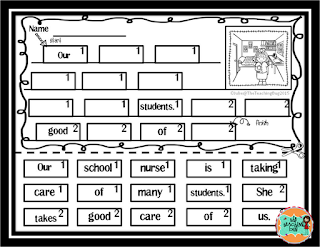
When children grasp phonics principles, they can apply this knowledge to spelling and writing. Understanding the sounds that correspond to different letters allows students to spell words phonetically, improving their overall writing skills. It gives them the tools to express themselves more accurately and effectively in written form.   As you can see they will be able to complete activities like this:


Adequate phonics instruction will encourage the child to write and spell words to make complete sentences.  

3. Enhanced Vocabulary:

Phonics instruction helps children break down words into their individual sounds and understand the meanings associated with those sounds. This understanding is a stepping stone to building a robust vocabulary. As children learn to decode words and comprehend their meanings, their vocabulary expands, enriching their reading experiences.


4. Boosted Reading Fluency:

By mastering phonics, children can read more fluently and with greater speed. Recognizing letter-sound relationships effortlessly allows for smoother reading, which is crucial for comprehension and enjoying the act of reading. Reading fluency is a key component in academic success and fostering a love for literature. Short passages like this,


 are great ways to build fluency for young learners.  

5. Confidence and Independence: 

Most importantly when children can decode words independently, it instills confidence in their reading abilities. Phonics empowers them to tackle new words and texts without constant assistance. This newfound confidence encourages a love for reading and nurtures a sense of independence in their learning journey.

6. Early Intervention for Struggling Readers:

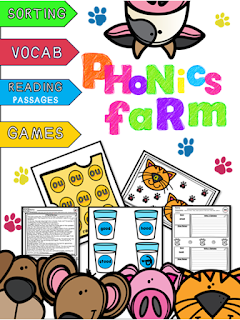
Phonics instruction is especially vital for children who may face challenges in learning to read. Early identification of reading difficulties and targeted phonics interventions can help these struggling readers catch up with their peers and prevent further learning gaps.  Continuous and daily practice is key for those learners who need extra support.  Daily practice of sounding out words and hearing the sounds will help them tremendously.  Adding in fun games and word sorts is just one of the ways to incorporate phonics into your daily instruction.  Some examples like these:  


If you'd like to have some interactive phonics activities to add to your reading groups you can check this unit out.  It's a great resource to use during small groups.  You can get it here:  (click on
picture to be taken to it)


 The early years of a child's education are crucial for developing foundational skills, and reading comprehension is undoubtedly one of the most important among them.  As children progress from kindergarten to first grade, they embark on an exciting journey of exploration and learning.  Cultivating effective reading comprehension skills during this phase sets the stage for a lifetime of successful learning.  In this blog post, we'll delve into strategies that parents and educators can use to help kindergarten and first-grade students build strong reading comprehension skills.  

1.  Creating a Reading-Rich Environment

Encouraging a love for reading begins at home and in the classroom:

a.  Surround with Books:  Fill your child's environment with age-appropriate books on various topics.  Let them see reading as an enjoyable activity. Some age appropriate books at this age are "The Three Little Pigs" and "Goldilocks and the Three Bears"


b.  Read aloud:  Regularly read aloud to your child, using expressive voices and engaging storytelling.  this models fluent reading and exposes them to new words.

c.  Story Discussions:  After reading a story, ask open-ended questions like "What was your favorite part?" or "What do you think will happen next?" This fosters critical thinking.  

2.  Building Vocabulary

A strong vocabulary is a foundation for comprehension:

a. Word Games:  Play word games like "I Spy" or rhyming games.  This boosts vocabulary while making learning fun.  

b.  Word Meaning:  When encountering new words, discuss their meanings using simple explanations and examples.

3.  Phonics and Phonemic Awareness

Understanding the sounds of language aids in reading:

a.  Rhyming Activities:  Engage in rhyming games and songs.  This hones phonemic awareness, helping children recognize sounds in words.

b. Letter Recognition:  Introduce letters and their sounds gradually.  Use magnetic letters or alphabet puzzles. 

4.  Predicting and Inferring

Developing prediction and inference skills enhances comprehension:

a.  Picture Walk:  Before reading, explore the book's pictures.  Ask your child to predict what the story might be about.  

b.  Discuss emotions:  While reading, inquire about the characters' feelings.  Encourage your child to infer emotions from the characters' actions.  

5.  Retelling and Summarizing

Summarizing helps consolidate understanding:

a.  Retell Stories:  After reading a story, have your child retell it in their own words.  This demonstrates their grasp of the plot.  

b.  Story Elements:  Ask about the story's beginning, middle, and end.  Discuss characters, setting, and the main problem.  


6.  Active Engagement

Engaging with the text strengthens comprehension:

a.  Pointing and Tracking:  Encourage your child to follow the words with their finger as you read aloud.  This teaches them that reading happens left to right.  Examples of pointing and tracking are passages like this which allow students to track as they are reading.  


b.  Ask "Why" and "How" Questions:  Encourage thinking beyond the literal text by asking questions like " Why do you think the character did that?" or "How would you feel in that situation?"

Kindergarten and first grade mark the early stages of a child's reading journey.  By creating a reading-rich environment, focusing on vocabulary, developing phonics awareness, practicing predicting and inferring, mastering retelling, and engaging actively, parents and educators can nurture strong reading comprehension skills.  Remember, the goal is not just to read words but to understand and connect with content.  As children grow into confident readers, these skills will serve as the building blocks for their future academic success and lifelong love of learning.  


 Today I am talking about Money.  We could all use a little more right?  Well in my classroom I have noticed that some of my students grab the concept of coin identification quickly and others do not.  Then after a few short weeks we are expected to teach our students how to add up money and count it.  AHHH it can be a struggle.  One thing I have added to my math centers for practice are these money identification strips that have helped my students at the beginning of our money unit.  You can grab them free here:


   Once we move on from those task cards I add a little fun activity into the center with these Ipad tablet shaped task cards.  These were laminated over the summer and cut out to fit right into my storage containers for math.  My students are to identify the amount of money and circle the coins they would need to make the amount listed.  They have a recording sheet to use so that I can check for understanding.  You can grab them here:
  

Once we moved on from using our Ipads we went onto these locks which were a hit with the kids if they like puzzles.  These keys and locks were laminated and I asked a parent volunteer to help me cut them out.  Win win on a time saver.  These locks were a lot of fun for the kids to place together especially for my tactile learners.  You can grab them here:  

 Next we move onto the newest activity that I plan on adding to the centers for next school year.   These reading passages can be used two different ways.  I can print them out and have my students complete them independently for morning work or add them to my math center.  I plan on adding velcro to the backs of the pieces and to the cards after they have been printed out on cardstock and laminated.  I can't wait to hear my students reading and adding a little math to their day.  We love cross curricular activities in my room.  You can grab them here:  


Featured

I hope you find these examples useful in your classroom.


                                                *** This post will contain affiliate links*****

   One of my favorite things to discuss with my guided reading groups is figurative language.  Why???  you might ask.  Well, because it can add so much to our reading and writing instruction time.  My students love hearing and pointing out examples of simile, onomatopoeia (love saying this word), alliteration, personification, hyperbole, and idioms.  I love that we can enrich our reading time with more strategies to help our little readers and writers blossom .  

Here is how my lessons go:  

Guided Reading Groups:
    During our guided reading times we begin by introducing each skill individually with many examples to help my readers understand how to detect and find them in their reading.  First, we start off by taking simple notes and adding them to our interactive notebooks we keep for reading and grammar.  Here below we glue in the definition and then I have my students write examples of the skill around the gumball machine.    I have found that I like to use standard spiral notebooks for my interactive notebooks because we can add full pages and notes.  


     During our next meetings we will have one book on hand that we will read and share that illustrates the example of the figurative language we are working on (hyperbole, idiom, alliteration,etc).  As you will find in the pic above I have a piece of literature I use with each skill and we record our findings on the note cards which we add to our notebooks. 
Very guided at this point to assure that my students are learning and understanding the concept.  
Independent Practice
   After we have covered two of the figurative language styles or more whichever you group is comfortable I use these interactive activities to informally assess my students while I am working in our reading groups.  These pages are designed for my students to independently cut apart and glue down their answers on the page.  They are instructed which set to cut out and then they complete the activity independently.   Work is placed in their interactive notebooks and then I can check when we meet for their reading group.  
Here is a sample of our finished product in our notebooks.  :)  

Task Cards
    After informally assessing where my students were I also added these task cards to my reading centers or as tasks for my students to complete while I was working with my reading groups.  Students were told which bags to get out either A,B,C, D,... depending on which ones we had covered at that point and then given a recording sheet to work as partners to identify the correct example of figurative language.  Each task card is labeled with the alphabet and you know as the teacher which letter corresponds with which figurative language.  :) 


Culminating Activity
      Now I don't know about you but I like to have a little fun in my classroom and sometimes a game is what you need to get those kiddos motivated to learn.  As we wrap up all of our learning and we have grasped all the concepts of figurative language I like to play "Pop, I know that!"  A little game I created to challenge my students.  Divide the class into two teams and have the cards placed face up in a row along a set of desks.  Each team sends up a player and then either the teacher or another student reads "Pop, I know that" card and the first player who correctly grabs the Pop I know that card with the correct figurative language word on it gets a point for their team.  It is so much fun and the kids love playing.  


This was such a fun little unit and my students loved the gumball theme with the bright colors and learning all about figurative language.  If you like what you see you can get it here:  


Here is also a list of the books we used during our unit which were great examples for our guided reading meetings.  

Book Sources

By Dr. Seuss

By Peggy Parish
By Dr. Seuss

By Virginia Lee Burton


I hope your students enjoy it as much as mine did. 

  Hey Everyone!  I wanted to share with you a little activity that is going on in our math classroom as we wrap up graphs.  I can not tell you how much it makes this reading teachers' heart happy when I can use a picture book to tie in a lesson in math.   I just love going across the curriculum for my activities. 

Anyway here is what we did:

https://www.teacherspayteachers.com/Product/Sir-Cumference-Graphing-Math-Interactive-Center-3645198
We listened to our story:  I had a copy of the book on hand but you can easily find a read aloud on You Tube.  :) Next, we broke up into small groups and each group had a bag containing these graphs printed on cardstock and the manipulatives to create pictographs on their own.  Each student also had a copy of the mini book which I would collect later for a grade and then add it to their interactive notebooks. 


While they are working on their graphs and reviewing their skills they have learned this gives me the opportunity to work with those students who may still be struggling with different concepts on each of the graphs. 
Once our math center time is completed the students will turn into to me their finished books.  They look like this: 

So cute and a great way to add a grade to my gradebook for math.  This is perfect for small group math centers. 
If you like what you see you can get it here: 
https://www.teacherspayteachers.com/Product/Sir-Cumference-Graphing-Math-Interactive-Center-3645198

Thanks for stopping by! 


 HOW WE LEARN TO VISUALIZE

 One of the many reading strategies I try and teach my struggling readers is to visualize what they are reading.  Research has shown that students who are struggling with reading comprehension actually benefit from visualizing the material they read.  Creating what I like to call a T.V. in their head. 

  So how do we do it in my classroom???  Well we start off with several mini lessons using small sentences to get us started practicing the skill.  A sample sentence would look like this:

   " Sam was so excited to see all the balloons hanging around the room.  He saw his superhero cake on the table beside a pile of presents he could not wait to open.  "

  After reading this sentence I grab our white boards and then we draw what we saw.  We would draw a cake, balloons, and Sam.  We talk about how to create those pictures in our head.


HOW WE PRACTICE THOSE SKILLS

  After many lessons and practice using the skills, I decided it was time to take our lesson one step further.  We plan on looking at small passages and highlighting key words that will help us visualize after each small paragraph.  As we read the paragraphs we will go back with our pencil and highlight those key words that help us visualize what the passage is about. 
Next, we take a look at the pictures below our paper and check out which ones would be a best fit to the words we highlighted in each paragraph. 


   Finally, we glue them on and then check in our passage to make sure we visualized the correct picture to go with the passage. 

 The stories I created follow a theme and there is one for each day of the week.  On Friday my students are given review questions to practice their comprehension skills over the week. 

You can find these pages here:


In the past, teaching my kindergartners to write sentences was challenging.   You have little ones who can not quite read yet.  Often I heard I don't know what to write about or we would provide them a picture and some of them could write a sentence and others could not.  So this activity came to mind and it worked.   We used this over and over again before we turned them loose on their own sentence writing. 

First,  I modeled the activity and walked the students through each part step by step.  At this age that is critical to success.  I laminated all the pieces, just my preference, and then once it was modeled I had the students work with the one sentence collection with partners.  Each page has a different picture on it so the kids can see what their sentence is about.  It also helps them think about some other sentences they can add  to it later.  Each group was required to get their sentences put together correctly and then have me and my assistant to go around and check.  Then the children were given the recording sheet to write out the sentence they made.  The next day we used the same sentence sheets but they were switched among the groups so the kids did not receive the same one and asked the do the activity again. 
   For the first week or so, depending on my group, I had the first set of one sentence sheets placed in my writing center.  After they seemed to get it and we worked on additional sentence making activities I introduced the next set of two sentences and then finally the set of three sentences. 

The recording sheets that are included in the pack were turned in at the end of the center activity time and it let me assess to see who was struggling with forming sentences. 

After the kids worked for a while on these.  I also required them to come up with a sentence on their own and record it on the recording sheets as they progressively got better. 


https://www.teacherspayteachers.com/Product/Sentence-Building-Activity-Center-Kindergarten-First-Grade-2125408


If you like what you see you can pick it up here:
  
https://www.teacherspayteachers.com/Product/Sentence-Building-Activity-Center-Kindergarten-First-Grade-2125408
Design by Delightfully Creative. Powered by Blogger.