The Teaching Bug!: writing

Showing posts with label writing. Show all posts


Phonics, the relationship between sounds and letters, is a fundamental skill in learning to read and write. We already know that phonics in the classroom is a cornerstone of early literacy education, setting the stage for a lifetime of successful reading and language comprehension. But today let's delve into the significance of incorporating phonics into the curriculum and how it lays a strong foundation for a child's literacy journey.

1. Foundation for Reading

Phonics is the bridge that connects the spoken language to the written word. Understanding the sounds of letters and how they come together to form words is essential for reading proficiency. Teaching phonics equips children with the ability to decode unfamiliar words, enabling them to read with confidence and comprehension.

2. Improved Spelling and Writing

When children grasp phonics principles, they can apply this knowledge to spelling and writing. Understanding the sounds that correspond to different letters allows students to spell words phonetically, improving their overall writing skills. It gives them the tools to express themselves more accurately and effectively in written form.   As you can see they will be able to complete activities like this:


Adequate phonics instruction will encourage the child to write and spell words to make complete sentences.  

3. Enhanced Vocabulary:

Phonics instruction helps children break down words into their individual sounds and understand the meanings associated with those sounds. This understanding is a stepping stone to building a robust vocabulary. As children learn to decode words and comprehend their meanings, their vocabulary expands, enriching their reading experiences.


4. Boosted Reading Fluency:

By mastering phonics, children can read more fluently and with greater speed. Recognizing letter-sound relationships effortlessly allows for smoother reading, which is crucial for comprehension and enjoying the act of reading. Reading fluency is a key component in academic success and fostering a love for literature. Short passages like this,


 are great ways to build fluency for young learners.  

5. Confidence and Independence: 

Most importantly when children can decode words independently, it instills confidence in their reading abilities. Phonics empowers them to tackle new words and texts without constant assistance. This newfound confidence encourages a love for reading and nurtures a sense of independence in their learning journey.

6. Early Intervention for Struggling Readers:

Phonics instruction is especially vital for children who may face challenges in learning to read. Early identification of reading difficulties and targeted phonics interventions can help these struggling readers catch up with their peers and prevent further learning gaps.  Continuous and daily practice is key for those learners who need extra support.  Daily practice of sounding out words and hearing the sounds will help them tremendously.  Adding in fun games and word sorts is just one of the ways to incorporate phonics into your daily instruction.  Some examples like these:  


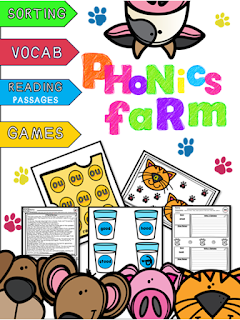
If you'd like to have some interactive phonics activities to add to your reading groups you can check this unit out.  It's a great resource to use during small groups.  You can get it here:  (click on
picture to be taken to it)


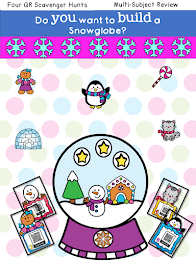
 I don't know about you but we've all seen those little QR codes that some T.V. commercials have floating across the screen.  This inspired me to add this to my classroom.  I wanted my students to scan a QR code to discover different clues around our classroom.   I wanted to share with you a fun and interactive way to review some math and geography skills and encourage your students to write a detailed and imaginative story once the hunt is complete.  Let's get started:

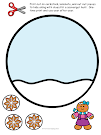
Print out these sheets (this is just a sample of some of the cards you need to print out) on cardstock and laminated them to use year after year.  Timesaver right??? There are also optional task cards if you prefer to set this up in a center for partners to do after completing the scavenger hunt. One more way to use the activity.  


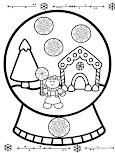
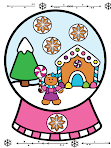
You'll decide whether you want to set up one scavenger hunt or two, three, or four. Set up at the desk or table with a copy of the globe pieces, the black and white copy of the snow globe, and the color copy of the snow globe (optional for reference). See pic above.  

 Each hunt has a different themed snow globe and students work in groups and go to different parts of the room at different times.  You'll only need one tablet per group and allow students to take turns scanning the code.  There are 10 different cards per hunt.  Each child will get a turn.  Students have an answer sheet to record their answers. Each clue card tells them which part of the snow globe they will build back the designated desks or tables where the black and white copy of the globe is located.  
Once the hunt is over and students have answered and found all the clues then they will return to their seats and write a story about the snow globe they built together. One group will write about the gingerbread snow globe, or the snowman snow globe, etc.  

If there is time for you to add to the activity students can color a black-and-white copy of the snow globe to go along with their story.  

Pack up all the pieces and clue cards and set it aside to use year after year.  Only thing you would have to print out is the writing sheets and the answer sheets.  

If you like what you see you can grab it here: 


                                                *** This post will contain affiliate links*****

   One of my favorite things to discuss with my guided reading groups is figurative language.  Why???  you might ask.  Well, because it can add so much to our reading and writing instruction time.  My students love hearing and pointing out examples of simile, onomatopoeia (love saying this word), alliteration, personification, hyperbole, and idioms.  I love that we can enrich our reading time with more strategies to help our little readers and writers blossom .  

Here is how my lessons go:  

Guided Reading Groups:
    During our guided reading times we begin by introducing each skill individually with many examples to help my readers understand how to detect and find them in their reading.  First, we start off by taking simple notes and adding them to our interactive notebooks we keep for reading and grammar.  Here below we glue in the definition and then I have my students write examples of the skill around the gumball machine.    I have found that I like to use standard spiral notebooks for my interactive notebooks because we can add full pages and notes.  


     During our next meetings we will have one book on hand that we will read and share that illustrates the example of the figurative language we are working on (hyperbole, idiom, alliteration,etc).  As you will find in the pic above I have a piece of literature I use with each skill and we record our findings on the note cards which we add to our notebooks. 
Very guided at this point to assure that my students are learning and understanding the concept.  
Independent Practice
   After we have covered two of the figurative language styles or more whichever you group is comfortable I use these interactive activities to informally assess my students while I am working in our reading groups.  These pages are designed for my students to independently cut apart and glue down their answers on the page.  They are instructed which set to cut out and then they complete the activity independently.   Work is placed in their interactive notebooks and then I can check when we meet for their reading group.  
Here is a sample of our finished product in our notebooks.  :)  


Task Cards
    After informally assessing where my students were I also added these task cards to my reading centers or as tasks for my students to complete while I was working with my reading groups.  Students were told which bags to get out either A,B,C, D,... depending on which ones we had covered at that point and then given a recording sheet to work as partners to identify the correct example of figurative language.  Each task card is labeled with the alphabet and you know as the teacher which letter corresponds with which figurative language.  :) 


Culminating Activity
      Now I don't know about you but I like to have a little fun in my classroom and sometimes a game is what you need to get those kiddos motivated to learn.  As we wrap up all of our learning and we have grasped all the concepts of figurative language I like to play "Pop, I know that!"  A little game I created to challenge my students.  Divide the class into two teams and have the cards placed face up in a row along a set of desks.  Each team sends up a player and then either the teacher or another student reads "Pop, I know that" card and the first player who correctly grabs the Pop I know that card with the correct figurative language word on it gets a point for their team.  It is so much fun and the kids love playing.  


This was such a fun little unit and my students loved the gumball theme with the bright colors and learning all about figurative language.  If you like what you see you can get it here:  


Here is also a list of the books we used during our unit which were great examples for our guided reading meetings.  

Book Sources

By Dr. Seuss

By Peggy Parish
By Dr. Seuss

By Virginia Lee Burton


I hope your students enjoy it as much as mine did. 

Design by Delightfully Creative. Powered by Blogger.